Nacka Metro Station
Stockholm, Sweden
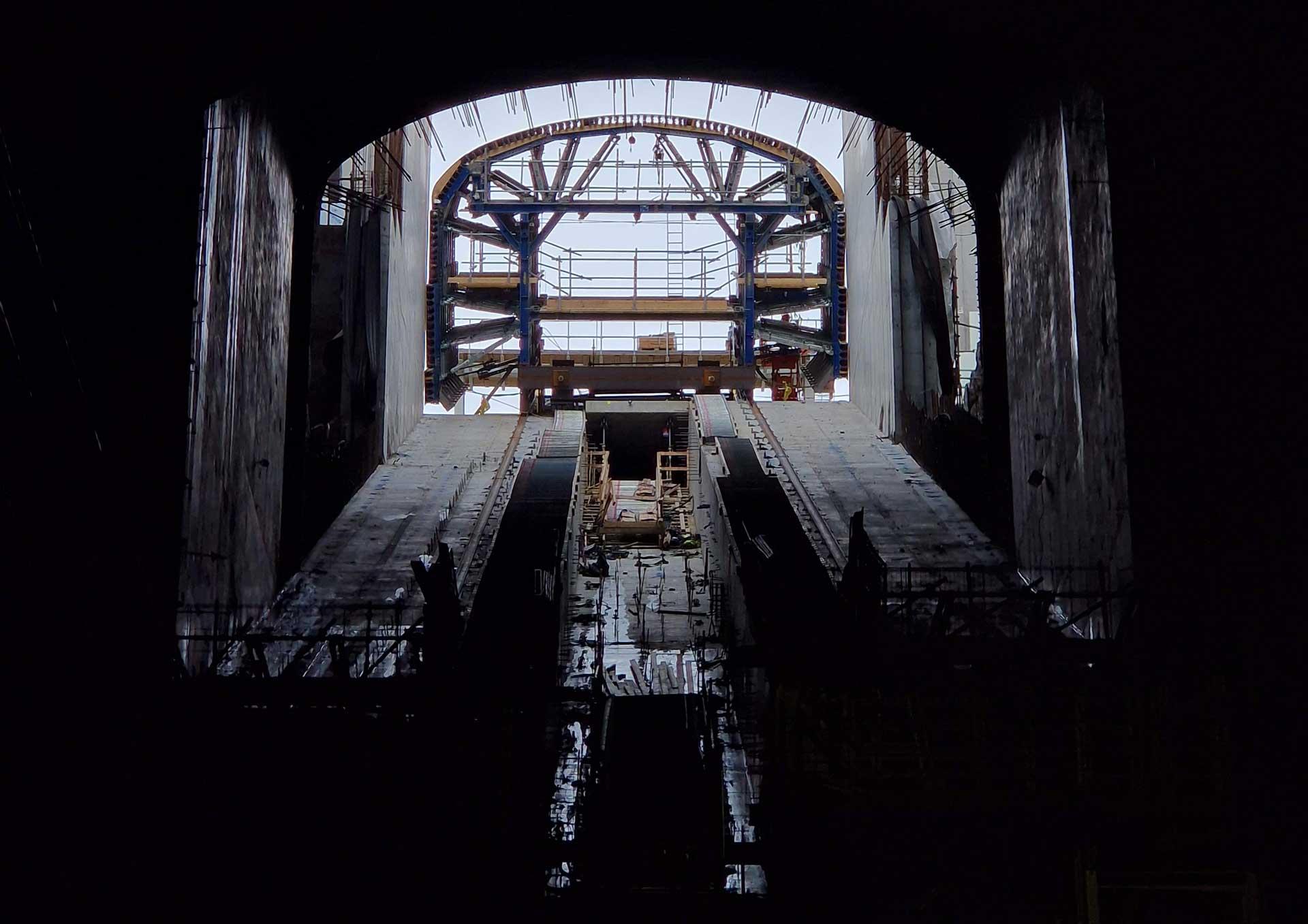
Doka at the heart of Nacka’s new metro station
The expansion of the Stockholm metro by Region Stockholm is one of Sweden’s largest ongoing infrastructure projects.
At the heart of this development, Nacka Station is taking shape — featuring Sweden’s longest escalator, approximately 100 meters long with a vertical difference of 41 meters. Delivering such a structure requires advanced technology, innovative solutions, and close early-stage collaboration with Skanska, where Doka has played a key role.
With its customized formwork systems and engineering expertise, Doka has ensured that the construction of Nacka Station not only meets stringent technical requirements but also promotes productivity, safety, and quality.
Once completed, passengers will travel through one of Europe’s most spectacular metro stations – and ascend an escalator that stands as a symbol of technical excellence and the future of urban mobility.
Building type
Mining tunnel with cut and cover portal.
Challenge
The formwork for an escalator shaft inclined at 27.3° in a tunnel where no crane could be used, presented a particular challenge. Different lengths of concrete section and severely restricted space conditions inside and outside the tunnel made the work even more difficult.
Solution
Horizontal assembly outside the tunnel, lifting to the required inclination using a Doka-UniKit platform and lowering the two-part SL-1 tunnel formwork traveller into the tunnel for concreting sections of varying lengths.


SL-1 on Doka UniKit: Power for extreme project challenges
One of the project’s greatest technical challenges inside the tunnel has been the extreme height conditions, heavy loads on slabs with overlying walls, an additional slab level above, and the lack of lifting equipment. To meet these demands, Doka designed an SL-1 tunnel traveller, enabling safe and precise concreting of the 27.3° inclined escalator tunnel.
Using Doka UniKit primary and secondary beams, the system could be assembled horizontally outside the tunnel before the 80-tonne SL-1 traveller was positioned at the desired angle and lowered with support from Skanska Stålteknik – providing a stable and robust solution throughout the process.
The two-part assembly and concreting sequence allowed the first section to be used for the initial 3.6 m pour while the second section was assembled in parallel. Once connected, the SL-1 tunnel traveller enabled the completion of the remaining section.
System solutions for heavy loads
Due to the considerable height and heavy loads, Doka supplied the Staxo 100 shoring tower system to support all arches, ensuring stability and safety in the most demanding sections. Where fast assembly and simplicity were required, the versatile Framax wall formwork system was used, while DokaXlight provided a lightweight system combining strength and flexibility – delivering both workflow efficiency and improved working conditions.

Mersedeh Sammak | Block Manager Concrete | Skanska Sverige AB
„The close collaboration with Doka’s technical team has been a key factor in the success of the project. Through open and continuous dialogue, we have been able to address design and structural calculation questions quickly and find effective solutions to challenges along the way. The mix of brief check-ins and more in-depth meetings with Doka’s designers and engineers in both Sweden and Austria has made our work smoother and more efficient“
From model to reality
To facilitate planning and coordination, Doka developed a detailed 3D model of the formwork systems. This has been crucial for handling interfaces with rock faces or precast elements, where confined spaces and the interaction between prefabricated structures, existing rock bolts, and ventilation ducts require precise clash detection. Thanks to the model, the project team could quickly identify deviations and potential problem areas, making the work more efficient and safer.
Project data
Year of completion
2026
Project duration
2023 - 2026
Country
Sweden
City
Stockholm
Contractor
Skanska Sverige AB
Building data
Construction method
Mining Construction Method
Section height
8.18 m
Section width
11.4 m
Section length
3.6 m - 11.7 m
Longitudinal inclination
27.3